
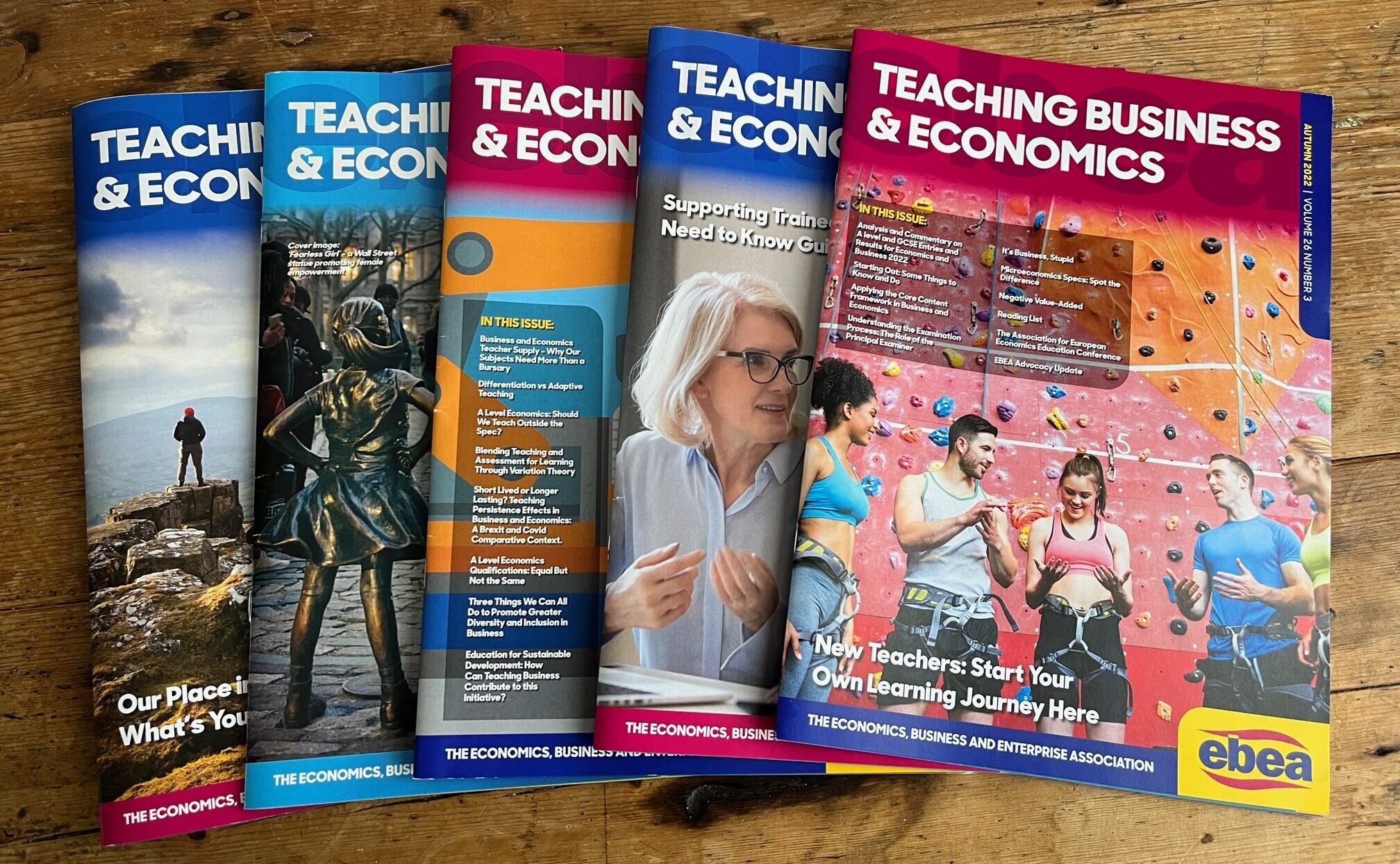
Teaching Business and Economics is the EBEA’s termly journal, dedicated to business and economics teaching in the 14–19 age range.
The journal aims to support the professional development of teachers in our subject area by providing a forum for sharing knowledge, insights, experiences and opinions. Teaching Business and Economics welcomes articles from across the profession. From experienced teachers, teacher educators and heads of department, to PGCE students and ECTs. We also welcome submissions from higher education, assessment bodies and any stakeholder with an interest in business and economics education. Articles are published in both the journal and on the EBEA website.
Contributors receive a copy of the journal and with the author’s permission, a copy also goes to their headteacher or principal acknowledging their contribution to our subject area. These article contributions can also provide evidence for DFE and school performance management standards. Teacher Educators may wish to link the article to their research profile, e.g. with a DOI.
If you have an article idea but would like some advice about what is needed, please contact the Editor, Gareth Taylor (editor@ebea.org.uk) who will be happy to provide assistance.
Planning Your Article
Articles broadly fall into the following categories:
- Pedagogical Approaches (2,500 words): articles that consider approaches to learning and teaching business and economics or current educational views and how they impact on business and economics education. Articles in this category are evidence-based and refer to other supporting research where appropriate.
- Learning in Practice (2,000 words): articles are based around a practical idea for teaching one or a sequence of lessons. Articles in this category will:
-
- Set the scene and the context – students, course, prior learning.
- Describe the learning outcomes and where this fits in the curriculum.
- Explain the learning process – what did you do, what did your students do?
- Reflect on what was effective and what could be improved next time, citing the evidence for these conclusions.
- Include resources where appropriate (these may also be accessed via the EBEA website).
- Articles in this category may also include images and samples of student work to illustrate points raised in the article.
- How to… (1,000 words): articles provide practical advice and strategies for business and economics teachers and departments. Articles in this category focus on approaches adopted as a teacher or as a teaching team. For example, choice of subjects and assessment bodies, extra curricula activities, enterprise and skills development, behaviour management, business contacts, trips and visits.
- Deeper and Wider (2,000 words): articles focus on improving and updating subject knowledge and propose approaches for teaching these topics. This might include sharing your own analysis of a topic area or recent development, or you may wish to develop an up-to-date case study that can be used to improve understanding of key concepts and theories. Anything that will contribute to teachers’ subject and curriculum knowledge.
- Advocacy (1,200 words): articles aim to be thought-provoking and spark debate about what and how we teach in our broad subject field. For example it might be how our subjects could change for the better, our subject’s place in the school curriculum, gaps in provision such as financial literacy or skills development.
Submitting Your Manuscript
Please email your article to the Editor of Teaching Business and Economics Adrian Lyons at editor@ebea.org.uk. The Editor will assess the suitability of your article for publication and where appropriate, ensure that it benefits from 'double blind (anonymous) peer review' to ensure that articles are of the highest quality.
The manuscript
The article should include a title, a sub-heading explaining the aim or focus of your article, your job title and institutional name and a recent head and shoulders picture. Remember to ensure that all sources have been referenced using the APA system of referencing. Guidance on using APA can be found at https://apastyle.apa.org/style-grammar-guidelines/references.
Please number diagrams and illustrations sequentially and include captions. Rough diagrams are acceptable and will be redrawn in design. Images should be of good quality and will usually need to be at least 1MB in size. When sending images that include pupils, please ensure you have secured parental permission to do so.
Copyright
Take care to specify the source of any material – text, images, data you use in your article. Please note that resources from the internet are not copyright free or free for re-use unless they specifically say so. For all material you use from other sources, (for example: text, adverts, figures, etc), please provide details of the source (i.e. title, author, date of publication, edition number, etc, or URL if it is sourced from the web). The editor will clear permission to use copyrighted material. An exception would be if you, as the author, have a working relationship with an organisation and can supply written permission that we can use their material in our publications.